Saturday, December 17, 2016

Next Humankind


Bristly limbs of bare trees scrape the December sky blanketing Kentucky hills. Vehicles zoom 65 miles an hour across formations 480 million years in the making. Ronin, seven months old, rides near the window, winter scenery streaming past him, his keen eyes the color of pine brush and moss, soft skin pale like sycamore bark. I watch his warm fingers dexterously grasp little toys in play; solid bones, sturdy as limestone, give structure that animates his energy. A wind, I imagine, whistles through the corridors of branches along those ancient mounds, paths as multifarious as dendrite gardens in the mind. I listen to my son's breathing, the gentle, vibrational "aaah" as he explores his own sound.

The people native to this land lived here for the better part of 15,000 years before they were assaulted with metal and gunpowder by white invaders. In a few hundred years, their territory has been sliced by highways, cut by machines seeking fuel for capital, drenched in the byproducts of oil and coal. Native people live here no longer. The people who remain, the poor, are dying of cancer. And then, there are also storytellers, weavers, farmers, midwives, and healers - those who rectify the desecration with their creative spirits. I recall the courage of the Northern water protectors and hear chords of their song settle in the valleys like fog.

My mind wanders from Appalachia to Aleppo, the children covered in white ash, unsure which breath may be their last. They have stopped crying; their eyes are tunnels that lead me to my own incriminating complicity. I sit comfortably on a cushion as their homes and safe places crumble, the ancient city a living ruin. Bomb blasts reverberate in humanity's foundation. Instead of speaking out, much of the world sips coffee through small plastic mouthpieces that will take the better of 1,000 years to break down. The darkness increases. I click screen buttons, send electronic dollars, in the false light of a cell phone. Oak, two years old, happily sings of silver and gold, of the light's return. I close my eyes and pray.

At the Smithsonian, Robby and I turned to find Oak with his arms around bronze statues of two early humans, a child and mother. He gently patted the little one's back, keenly peering in the direction of the small statue's gaze, inquisitive about what the elder figure seemed to be demonstrating. We silently observed our own child, descendant of these ancestral creatures, embody through his reflexive curiosity the evolution of their instruction. His touch was fond, familial. I saw through tears the exhibit headline, "Imagination Emerges."

Humankind has drawn invisible lines to create countries and concepts, using the mind as a template for terrain we can reconstruct. Young primates yet, we continue to grapple with what power we can wield to magnify our species' influence and centricity. But the nautilus spiral of Earth time betrays our flimsy superiority: the thin edge, nearly invisible, is human history, all 3 million years. In its unfathomable complexity, Earth boasts the majesty of 4600 million years. And we are citizens of a young planet in this unexplored universe, 15 billion years wide.

Cold, white marble, carved to look weightless, shoulders the recognizable Capitol domes. The extravagance distracts from the metallic taste of death, the smell of suffering, holding the place together like mortar. Countless African slaves worked to forge these spaces in which they were not regarded as human. The lofty ideals emblazoned on the walls, speaking of liberty and dignity, taunt the memories of African people whose rich heritage was scoured like ship decks, whose vibrancy has survived their oppression and their descendants'. "Out of many, one" - by force. The efforts of over 200 years have not yet made us a land of the free. To this day, only the survivors of oppression feel the heaviness, accurately estimate the cost. Their descendants are the prophets of our time, calling out in the wilderness of ignorance, holding aloft truth's torch.

In the belly of a colonial ship, Oak said, "A long time ago, I was down here and heard a loud BOOM." Running through the tunnel between Congress's Library and the Capitol Building, he remarked, "Before I was born, I was down here." Certain places hum with a story we somehow know we continue with the tones and cadence of our Voice. The trees and hills and sands and stars are still telling it. The children know the language and interpret for us in every unexamined gesture, every intentional question, every moment we stop talking long enough to listen, to breathe, to touch freedom. The scope of our lives can only be as broad as the understanding of our smallness.

I can imagine the next iteration of humanity: a species that looks in the mirror and sees a striving animal, that begins to only describe any individual with their chosen name, that participates as a cell in the body. The next humankind will absorb the sword into its heart and there dissolve it, will again discover fire but this time within, will honor abundance with temperance, will be led by the generations to come. The next humankind will know its humble place on the dirt. Our ancestors are waiting for us there, whispering the Soul's common fate.

"Aleppo" derives from the Aramaic word 'Halaba,' white like its soil and marble. The mountains ache like exposed joints, blasted and bald, empty caverns devoid of black coal, ghost canaries singing. I look up into the clouds swirling as in the soothsayer's sphere where questions answer each other. Freezing rain falls on the glass pane, running like rivers or neuron networks or veins, before evaporating into the atmosphere, eternal air and light.

Thursday, November 24, 2016

Gratitude Is

Gratitude does not recline in an oversized armchair, stuffed and surrounded in luxury, declaring, "I'm so thankful for what I have."

Gratitude leaves our mouths and arms open wide in wonder that WE EXIST when there could have been absolute no-thing-ness.

Gratitude makes us bare and vulnerable to the truth that nothing at all can be earned...everything we have is gifted by the ancestral universe.

Gratitude illuminates our rich happiness as intrinsically connected to all others' well-being.

Gratitude deepens the hunger to empty our pockets and lighten our packs to be more available to the Source, to nourish our Earth siblings, to share the infinite abundance of Life.

Gratitude requires us to investigate why everyone does not have enough.

Gratitude demands we defend the land, water, air, and diversity of this planet: our common birthrights.

Gratitude implores us to take only what we need so that others might live.

Gratitude insists that we care for each other in messy, challenging, unpopular, radical ways.

Gratitude is the sigh at the end of a day well-spent, whether with tears or pain or belly-aching laughter or deep soul gazes or whatever it took to feed our Children, whispering, "I am blessed to make the most of being alive."

Gratitude is the only redemptive final prayer.

Saturday, November 19, 2016

What Would Dory Do?

(Disclaimer: this is a very silly but personally relevant reflection on a Disney movie...use what's at hand, right?)
At the story's beginning, Dory despairs. She believes that she has lost what's precious to her because she is who she is: forgetful, flighty, and seemingly directionless. At times, she feels trapped by the idea that those qualities can only yield the same sad results in her life. She feels she can't do anything "right."
However, by the tale's end (no spoilers!), she realizes she can accomplish incredible things, in fact, BECAUSE of who she is. She's willing to take a risk without certainty of the outcome. She trusts her intuition even when there isn't a clear "reason." She is optimistic and "just keeps swimming" even when setbacks seem insurmountable. She depends on friends to help where she knows she can't rely on just herself. Her friends in search of her end up finding her because they ask, "What would Dory do?"
Eventually, Dory begins to *intentionally* lean into her wacky way of moving through the world. In several tense moments, she comically asks herself, "What would I do? What would I do?" Each time, she's saved by her own unique approach. At last, doing what Dory would do allows her to reclaim her losses.
These days, I'm trying to ask myself a similar question. Instead of feeling anxious and trapped, depressed or despairing, I'm trying to take a deep breath and repeat this mantra: "What would Mandy do?"
When I think of my most aligned, grounded, open self and who She could be in the world, I catch a glimpse of who I want to be and become. The Best Me is someone I want to be like. Just checking in with myself is a practice in intentionally living better, one step (splash!) at a time.
My friends, the wide ocean of possibility needs YOU to be just who and how you are. We need your weird, your clever, your unprecedented, your unimaginable ways. Only you can BE you, and only by being ourselves wholeheartedly can we just keep swimming together.
Dory doesn't only end up finding something that was lost "out there." The happy ending is that she found...Dory. Dory found Dory, and only she knew the way.
Today, please go in search of yourself, each moment you can pause and pursue you. Sift through the reflexive reactions or self-judgments. I implore you to ask yourself, "What would I do?"
The answer to that will help us ALL find ourselves. 

Sunday, November 13, 2016

Post-election Fireside Ponderings

🎶"We are the world..."
"What a wonderful world..."🎶
...songs and sentiments I want to believe.
We all just need warmth and light, someone to hold us.
We're all looking up at the same, big old moon.
But my friends' children are wailing in fear of their families being separated because they escaped here.
A child was murdered on the same street where I attended a baby shower this weekend...presumably because he was a refugee.
Brown and black neighbors in my city are being assaulted more blatantly because racist predators feel empowered.
These aren't illusions. The moon suddenly looks so big,
but in fact, it's even bigger... it's just so far away, it's easy to pretend we're imagining its enormity.
Fire breaks down everything it touches. We reflexively step back, stay safe...but sometimes, we're meant to walk right into it. Now, it's time.
In the end, personal relationships - and love - will save everything.

Thursday, November 10, 2016

Election Vigil

A family from Michigan was trying to distract themselves from the news and just happened to come to the Big 4 Bridge. The parents and three children were in Louisville for a work conference but couldn't stand sitting in the hotel room, feeling alone. As they approached the foot of the bridge, they saw a few folks gathered with candles. They were asked, "Are you here for the vigil?"

Afterward, they introduced themselves with profuse gratitude. "We had no idea something like this was going on. It was just what we needed." They were just what I needed, too.

Someone standing next to me caught my eye, smiling in the candlelight. "I'm the sister of the first man who was married to his partner in Kentucky," she told me. We tearfully embraced. "They both had to work tonight, but I wanted to be somewhere...for them. For me." For all of us.

A student, a lawyer, a college professor, a Waldorf teacher, an international nonviolent witness, a retreat leader, a doula, an academic, a massage therapist, a writer. Children, parents, activists, friends, siblings, teachers, neighbors. Louisvillians. U.S. citizens. Companions.

All holding a light.
All turning to one another, sharing their names, looking into one another's eyes.
All standing next to flowing water, common element, and bridges, structures of connection.
All holding their fears and hopes and angers and despairs and visions.
All singing, "Dona nobis pacem."
All nodding in recognition that we MUST listen to our children and let them lead us.
All imagining what we hope to see in a more just and peaceful world.
All choosing to show up on a cold night to be reminded of who we are, and that we belong to each other.

Gratitude for that circle of light. Let's tend it. Let's be nourished by it. Let's grow it. Let's use it for our collective liberation.

Tuesday, October 4, 2016

Attention

Pinks, blues, golds soften the steel gray of downtown at dawn. The clouds, the river, early light through the strati create an elemental symphony. As I watch the shades shift, inexplicably, thoughts of the hurricane in Haiti assail me. Mornings in Port-au-Prince, the taste of mango, the sun on tin roofs, smoke rising, memories older than a decade touch the present. I remember reading a friend's recent prayer to have her heart broken by the world's suffering. I cry at the wonder that all of this can inhabit a moment. My son remarks, "Clouds make thunder, Mommy." When I ask him what made him think of that, he replies, "Nothing."
We arrive home but none of us want to go inside. I hand my infant flowers and leaves, watch him delightedly grasp at the textures and sense the crackles with his whole little body. He looks at me as the sun rises higher and covers my head in warm rays; I see the gold in his hazel eyes. We gaze at one another, and I wonder if I have ever seen anything so magnificent. I realize he is looking at me with the same love-eyes. I suddenly feel alive.
Soon, I succumb to distraction and check Facebook on my phone. A friend's prompt, "Tell me something beautiful," leaves me eager to comment with details of my day. I read one woman's response that tells the story of her grandmother saying she'd reincarnate as a butterfly. That reminds me: an intuitive once told me that honeybees are a sign my great-grandmother, one of my early caregivers, is close by with a message. I smile at that lovely thought. I glance up from the small screen to see, with surprise, a single honeybee hovering in my line of vision. I set my phone down and watch it carefully, breathing deeply. I think, perhaps I had better keep paying attention to my life. She soon flies away. 
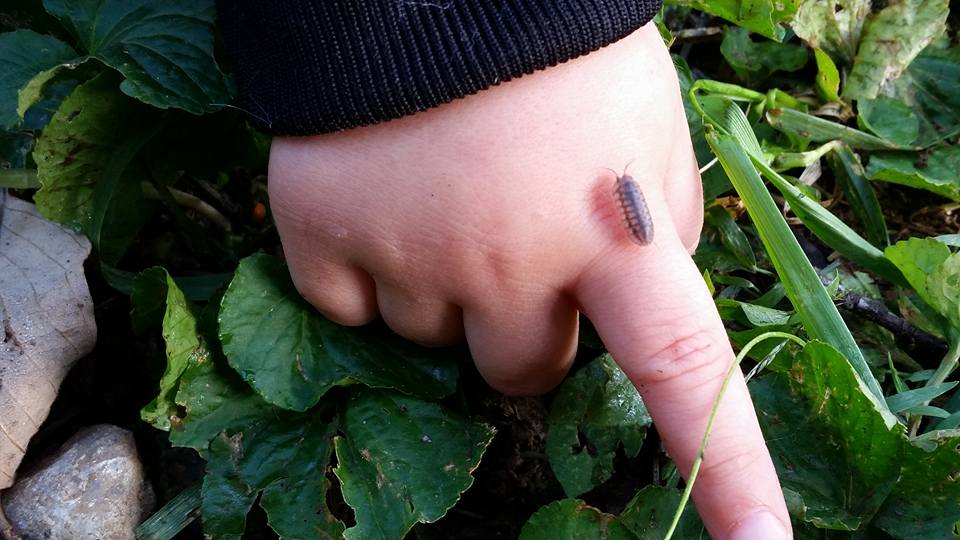
My oldest son follows a roly-poly as if it is the most important thing to do (isn't it?) until it crawls out of sight. "I miss her," he frowns, head bowing. Soon enough, though, another roly-poly is discovered. My boy gently offers his finger again and again until she crawls onto his hand. After some time with his friend, he remarks, "Now it's time for her to go to her Mommy." He carefully returns her to her stone, wishing her goodbye. "Go see your Mommy!"
An elderly woman who walks through my neighborhood most mornings, instead of waving and quickly continuing on her way, comes down the path to my front stoop to greet my toddler and coo at my baby. She takes obvious joy in their liveliness. "I'm going to try to get out and work in the yard," she comments. "Enjoy the beautiful morning," I say reflexively. After meandering talk, her voice quiets. "I've just been diagnosed with lung cancer." Words collapse in my throat, so I hold silence with her. With tears in her eyes, she looks once more at my children and walks away. I keen the edges of her sorrow. Watching her retreat, Oak softly says, "I love her."
My son stares at me intently when my own tears come. I explain that I'm sad our neighbor is sick. He holds out his arms, holds me, kisses me, says, "I love you, Mommy. Here, this make you feel better," and offers a drink of water. Once my tears are dried, he lays in the grass, saying, "I love laying in the grass under the brown tree. Me take a nap on the stones." I cradle my younger boy close and offer him my breast. Soft skin on soft skin, milk and tears, warmth and closeness, comfort in the healing pace of knowing, all at once, that you have plenty of time.
I tell the story of the pumpkin seed: that, someday, with the pattern hidden inside its pale shell, it will break open into a squash vine, which will yield as many pumpkins as there were seeds in the pumpkin from which it came. My infant quietly looks on. My toddler turns one seed over and over in his palm. Later, we cook the pumpkin flesh and sweet potatoes. We stir in coconut milk and spices. We are patient, letting the mixture simmer. We smell hints of a meal in the making, one we will share together with others who join us at the table. We listen to the noon bell chime.

Friday, September 30, 2016

Black Lives Matter.

Just now, Oak found my unfinished poster from the last LSURJ meeting (Louisville Showing Up for Racial Justice) and asked to finish it. "Look, Mom! 'Black Lives Matter' - me want to color green and red!" I couldn't believe he remembered me telling him what it was going to say WEEKS ago. He also remembers when we walked through downtown Louisville chanting the mantra several months ago. It's a phrase that already carries meaning for him because he sees that it carries meaning for people he cares about.
He added the colors, I added the final word. I'll hang up our collaboration somewhere others will see it, too. Why is this SO IMPORTANT to me?
I wholeheartedly support the BLM movement because my sons - ALL our children - will not inherit a nation in which all people are truly free. In fact, most people are NOT free. Since the beginning, the United States' economic and political schema has been dependent on systemic subjugation of First Nation peoples, Black persons, women, poor folk, etc. (I am constantly learning of new modes of oppression employed in my country). The U.S. is founded in racism. This is not debatable - it is a fact. The refrain of oppressed peoples in this country has been, for centuries, "America was never America to me," as the poet Langston Hughes once wrote.
Today, these histories of prejudice remain deeply rooted in our psyches as white people. Because we have been so profoundly conditioned by these histories, false narratives, and structures that serve to continue and further racism and oppression, we aren't even AWARE that we are prejudiced. In all real senses of the word, I am racist. Again: I AM RACIST. I can't help but be racist as a white person in this country. Since before I can remember, I have been internalizing imagery of thuggish black men, stereotyped native people, passive women, mocked queer folk, and ignorant poor people. We are swimming in these lies. It has taken years of listening and learning to realize the racist tendencies within me and to admit that they exist, even though I don't want them to.
The trick is to recognize I cannot immediately, or perhaps ever, rid myself of these internalized judgments...just like, no matter how hard I try, I may never be able to stop myself from feeling angry. What I CAN control is how I respond. I can notice with honesty what arises in me. I can listen more intentionally to people who I don't often hear from. I can admit when I'm wrong, blind, or ignorant. I can let myself be led by people who have been silenced for generations. I can start to see, think and talk about, and eventually move in the world differently. I can set my own mind-heart-soul free, little by little.
However, even as a white, middle class, cisgender, queer/bisexual, mostly femme-presenting woman, I am not free until my black siblings are no longer oppressed. My liberation is bound to everyone else's. Until every last human is respected, cared-for, and upheld, I and all others will be bound.
I feel uncomfortable putting these basic, boiled-down thoughts out there. It isn't because I am afraid that I'll be opposed; it's because I know how very much I have to learn. I know my language isn't totally correct. I left out sooo much. I surely messed something up badly. I know this is a childlike sketch of the journey I'm on. But this is a small piece to hopefully open a door of understanding for those who don't know why I am always saying, with passion, "Black Lives Matter." I am saying it because my own life depends on it, and so does yours, whoever you are. I will continue to learn so that I am more and more prepared to answer my children the day they ask, "Why do we say 'Black Lives Matter'?"
Want to learn more? Join me. Come to a SURJ meeting. Visit BLM's website. Read a book (I have some suggestions). Start talking to white people and listening to people of color. Let's connect. Let's grow together. Let's work toward our collective freedom.